(ESRS 2 SBM-3, ESRS S3-1, S3-3, S3-4, S3-5)
SOCIAL IMPACT

With the principle of “working responsibly for the future,” we focus on creating broad and meaningful positive impact, ranging from reducing environmental impact to generating social value.

Employee Volunteering
As Akçansa, we focus not only on our commercial activities but also on developing impactful projects with a strong sense of social responsibility. By taking proactive initiatives particularly in education, we support our stakeholders while implementing projects that inspire our industry.
Through collaborations with local stakeholders in the regions where we operate and the contributions of our employee volunteers, we develop projects that touch communities and create lasting social value. Over the past year, we delivered value to our stakeholders through initiatives such as the “My Volunteer Journey” program, activities organized on special occasions, and the NEET training program implemented in collaboration with the Sabancı Foundation.
Our “My Volunteer Journey” Project: STEM Talks
Through STEM Talks, implemented under our My Volunteer Journey program, Akçansa employees share their knowledge and professional experience with students. Throughout the year, our volunteers meet with primary, middle, and high school students across many cities in Türkiye, sharing how their expertise in STEM fields contributes to both their professional and personal lives. Through these engagements, we encourage young people to pursue careers in science, technology, engineering, and mathematics, supporting them in building a stronger future.
158
Volunteering hours as part of STEM Talks
687
Students reached as part of STEM Talks

STEM Workshop
Through the STEM Workshop, another initiative implemented within the scope of our My Volunteer Journey program, we aim to create an impact that supports equal opportunities in education, increases access to future skills, and sustainably expands social value. In collaboration with Bricks 4 Kidz, the project aims to introduce children to a STEM education program aligned with global standards, providing educational content that is often limited even in private schools. The workshops are conducted throughout the academic year for second-grade students at Akçansa Mehmet Akif Ersoy Primary School. Each year, the program aims to reach a different group of 400 children, ensuring that as many students as possible are introduced to STEM concepts and learning approaches.
In addition, on International Day of Women and Girls in Science (11 February), we organized a special STEM Workshop at Akçansa Mehmet Akif Ersoy Primary School to encourage children’s participation in science education activities. During the event, children learned, explored, and experienced the excitement of science by building selected LEGO models under the guidance of expert instructors.
NEET Trainings
In cooperation with the Ministry of Family and Social Services and the Ministry of Labor and Social Security of the Republic of Türkiye, we continued our training programs this year within the scope of the “Future Builders: Young Women Creating Their Future” project, implemented by the United Nations Development Program (UNDP) and the Sabancı Foundation. As part of the project, which focuses on the needs and challenges of young women in Türkiye who are not in education, employment, or training (NEET), we first organized two online sessions. On 31 October, we delivered a Sustainable Future Training, followed by a Digital Transformation Training Program on 5 November. In addition, we also held a full-day, face-to-face training session. We held a program at our Büyükçekmece Factory on 27 November, with the participation of NEET young women. The program included training modules on “Job Application Skills,” “Sustainable Future,” and “A Perspective on Digital Transformation”. During the program, participants gained comprehensive knowledge on job applications, interview techniques, and CV preparation. In the “Sustainable Future” session, topics such as the scope of sustainability, the responsibilities of individuals and organizations in this area, current developments, and future goals were discussed. The program concluded with the “A Perspective on Digital Transformation” session, where participants were introduced to the digital transformation journey of the business world, major technology trends, and the role of artificial intelligence.

University Collaborations and Technical Training Support
At Akçansa, we consider it one of our key responsibilities to support university students in complementing their academic knowledge with real industry practices and to contribute to their professional development. With this approach, throughout 2025, we organized technical field visits focusing on cement, aggregate, and ready-mix concrete production processes, with the participation of 250 students from 12 different universities.
As part of these technical visits, students had the opportunity to visit the Büyükçekmece Cement Plant and observe the entire cement production process from raw material sourcing to the final product on site. During the visits, in addition to the production stages, detailed information was shared about the roles, technical expertise, and operational contributions of the engineers working at the facility. Through these experiences, students gained the opportunity to directly observe how engineering knowledge is integrated with practical field applications.
Students also visited the Büyükçekmece Ready-Mix Concrete Plant, where they closely examined the ready-mix concrete production processes. During these visits, detailed information was provided about the advanced technological equipment, automation systems, and quality control mechanisms used in production. The sessions also explained how concrete is designed according to different application areas and how sustainability and efficiency principles are integrated into production processes. In addition, explanations on the testing methods used to determine the properties of concrete in both fresh and hardened states helped students better understand the role of quality management and innovation in production processes.
Within the scope of the program, students also visited the Agregasa Saray Facilities, where they received detailed information about the extraction, classification, and production processes of aggregates, one of the key components of concrete. The impact of aggregate production on concrete performance and its importance for quality management were also demonstrated through practical explanations.
During visits to the Akçansa Technology Center Laboratory, students gained technical knowledge on concrete production, testing, and experimental processes, while also closely observing quality control, product development, and innovation activities carried out in a laboratory environment. In addition, presentations were delivered on special concrete products developed by Akçansa and their areas of application. Through these technical visits, students had the opportunity to evaluate the building materials sector from a holistic perspective, covering all stages of the production value chain. With these initiatives, we aimed to increase students’ professional awareness and contribute to their career planning.
Beyond technical visits, Akçansa also implemented an important university–industry collaboration program with İstanbul Arel University. The course titled “Sustainable Building Materials with Akçansa,” which began with its first lecture on 1 October, offered civil engineering undergraduate students a rich learning experience that combines current industry knowledge, practical insights, and case study analyses, providing them with a strong sectoral perspective.
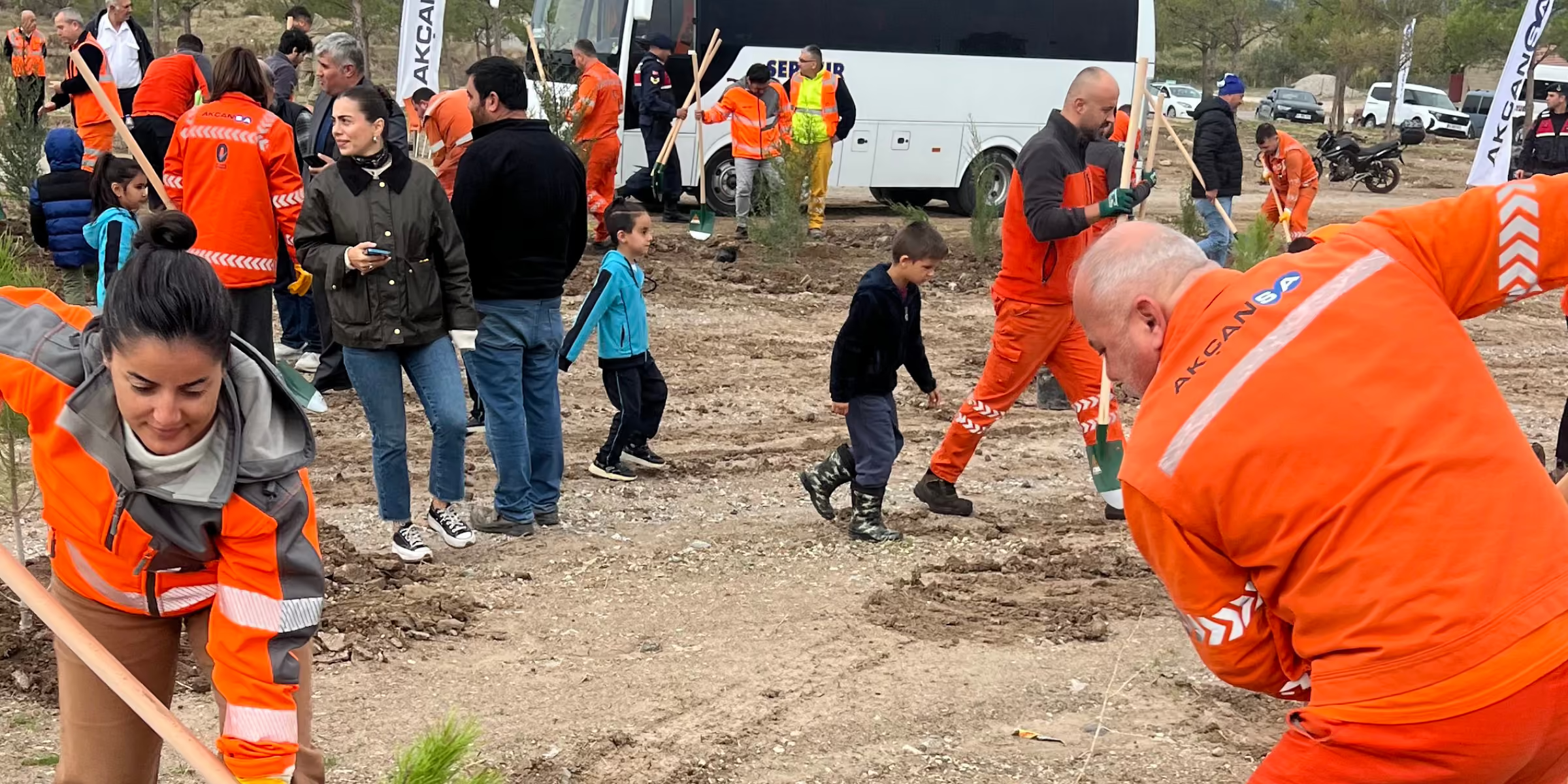
Tree Planting Events in Çanakkale and Samsun
This year, we continued our sustainability efforts with two important initiatives. We came together with local communities through tree planting events that contribute to nature. As part of the event organized in Pınarbaşı Village in the Ezine district of Çanakkale, saplings of black cypress, stone pine, firethorn, abelia, and plane trees were planted. In addition to our employees, the event was attended by Ezine District Governor Yusuf Kaptanoğlu, students from Pınarbaşı Primary School, and members of the local community. While contributing to the environment, the event also created meaningful social value for the region.
A similar initiative took place in Ladik, where Scots pine and black pine saplings were planted at Samsun 19 Mayıs University Vocational School. Alongside our employees, participants from the university also joined the event, which concluded with a commemorative group photograph.
In both Çanakkale and Samsun, we came together and planted saplings hand in hand for a more sustainable future.

Stakeholder Engagement Plan
The Stakeholder Engagement Plans we developed this year for all our facilities were designed to make our communication with stakeholders in the regions where each facility operates systematic and continuous. Through these plans, we not only identify the expectations and needs of our stakeholders, but also regularly collect and evaluate their suggestions, feedback, and concerns. This approach enables us to better manage the environmental, economic, and social impacts of our activities while strengthening the social value we create. As of 2025, the implementation rate of these Stakeholder Engagement Plans reached 54%. In the coming period, we will continue our efforts to increase this rate and ensure the more active participation of a broader group of stakeholders in the process.

Relations with Local Communities and Akçansa’s Contribution to the Local Economy
We completed another year in which we continued implementing projects that create positive social impact in the regions where our factories operate. At our Ladik Factory, we continued the “Ladik Glass Workshop” initiative, which encourages the participation of employees’ spouses and local women from Ladik in production activities. Within the scope of the program, participants received glass and cold ceramic training courses. In addition, we signed a cooperation protocol with the Ladik District Directorate of National Education to organize general, vocational, and technical courses in artistic, sports, cultural, and professional fields.
We also sponsored the ChemE Cube Competition, organized by Ondokuz Mayıs University Chemical Engineering students, where participants presented mobile and low-cost systems designed to provide access to water in disaster situations or under limited resource conditions. Furthermore, we organized a tree planting event at the university’s Vocational School, where our employees and university participants planted Scots pine and black pine saplings together. In March, we also held a STEM Talks session at OMÜ Vocational and Technical Anatolian High School, sharing our STEM-related experiences and knowledge with students.
This year, we carried out many important social and environmental initiatives in Çanakkale. We supported firefighting efforts in the region by providing both equipment and personnel assistance. In addition, we came together with the local community through a tree planting event aimed at contributing to a more sustainable future. As part of the event organized in Pınarbaşı Village in the Ezine district of Çanakkale, saplings of black cypress, stone pine, firethorn, abelia, and plane trees were planted. In addition to our employees, the event was attended by Ezine District Governor, students from Pınarbaşı Primary School, and members of the local community. While contributing to the environment, the event also created meaningful social value for the region.
We also organized our STEM Talks sessions in two schools in Çanakkale, where our employees shared how their STEM expertise contributes to both their professional and personal lives. Within this scope, we met with students from Ezine Vocational and Technical Anatolian High School and Ayvacık Mehmet Akif Ersoy Vocational and Technical Anatolian High School. Furthermore, in line with the importance we place on supporting local employment, half of the blue-collar employees we hired in 2025 were recruited from nearby villages.
At our Ladik Factory, we continued the “Ladik Glass Workshop” initiative, which encourages the participation of employees’ spouses and local women from Ladik in production activities.