
(ESRS E2-3, E2-4)
WATER MANAGEMENT

We analyze water-related risks, implement practices aimed at reducing water consumption, and utilize innovative methods to increase water recovery.

Water scarcity in the industrial sector is among the major environmental risks that may directly affect production activities. Considering the need for cooling water in production processes, sustainable water management stands out as a critical focus area for Akçansa.
Protecting water resources and ensuring their efficient use are among our key priorities for strengthening the long-term resilience of our operations and reducing our environmental impacts.
Accordingly, we regularly assess water-related risks, take actions to reduce water consumption, and implement innovative solutions that enable access to alternative water sources.
When assessing water-related risks, we systematically monitor the latest data and projections published by the State Meteorological Service and the Ministry of Agriculture and Forestry of the Republic of Türkiye. By integrating our analyses with IPCC climate scenarios, we address medium- and long-term drought risks through a comprehensive perspective.
We develop both preventive and adaptive measures for drought management and structure all related initiatives within the framework of our Water Master Plan, which serves as our corporate roadmap in this area.
Our water management strategy is integrated into our enterprise risk management processes and includes concrete practices aimed at protecting water and marine resources across our operations and supply chain.
The CEO Water Mandate, developed by the United Nations based on the recognition that global water management challenges pose significant risks for industry, governments, local communities, and ecosystems, aims to improve corporate water stewardship and promote the sharing of knowledge and experience in collaboration with governments, civil society organizations, and other stakeholders. As Akçansa, we became the first company in the Turkish building materials sector to sign the CEO Water Mandate, an initiative of the United Nations Global Compact. Within this framework, we aim to take a leading role among sector stakeholders in our country in advancing water management practices across our areas of impact.
Our Water Management Policy
As Akçansa, the main objective of our policy adopted to ensure the protection and efficient use of water and marine resources is to minimize our environmental impacts, secure the sustainable use of water, and reduce our dependence on water. Within this framework, the main areas covered by our policy are as follows:
Efficient Use of Resources
To reduce water consumption and manage resources responsibly, we collect rainwater and surface water and implement recycling practices. In line with our goal of reducing our water footprint, we have integrated water recovery systems and digital monitoring technologies into our production processes and continue to expand them. In line with our target of reducing water use by 20% by 2030, we have commissioned IoT-based meters at three of our cement plants. While water consumption is digitally monitored through 63 smart meters in Çanakkale, 21 in Büyükçekmece, and 17 in Ladik, we have established a strong infrastructure for the rapid detection of leaks and losses and for process improvements.
Management of Risks and Opportunities
We assess water-related risks in accordance with the ISO 14001 Environmental Management System and the recommendations of the TCFD (Task Force on Climate-related Financial Disclosures). At our facilities in the Marmara, North Aegean, and Yeşilırmak basins, we take preventive measures to manage risks such as water stress, drought, and water scarcity. In addition, through our “Water Management Plan” and the “Water Master Plan” approved by the Board of Directors in 2024, this year we again optimize water management practices suited to local conditions at each of our facilities. Within the scope of the 2025 updates, the relevant plan has been expanded to also cover our ready-mix concrete plants.
Operational Excellence and Responsible Water Management
To reduce water consumption and improve energy efficiency, we use Best Available Techniques (BAT) and adopt a life cycle assessment approach in our production processes. We evaluate opportunities for reuse by recycling wastewater generated from production. Our long-term roadmap in water management is aligned with the United Nations Sustainable Development Goals and the UN Global Compact.
Stakeholder Communication and Transparency
We regularly and comprehensively report our ESG key indicators and maintain active communication with local communities, water authorities, and other stakeholders. In water management processes, we engage with communities by holding Neighbor Council meetings and additional meetings in line with the requests of relevant parties. The feedback obtained from these processes is taken into account in the development and implementation of our policies.
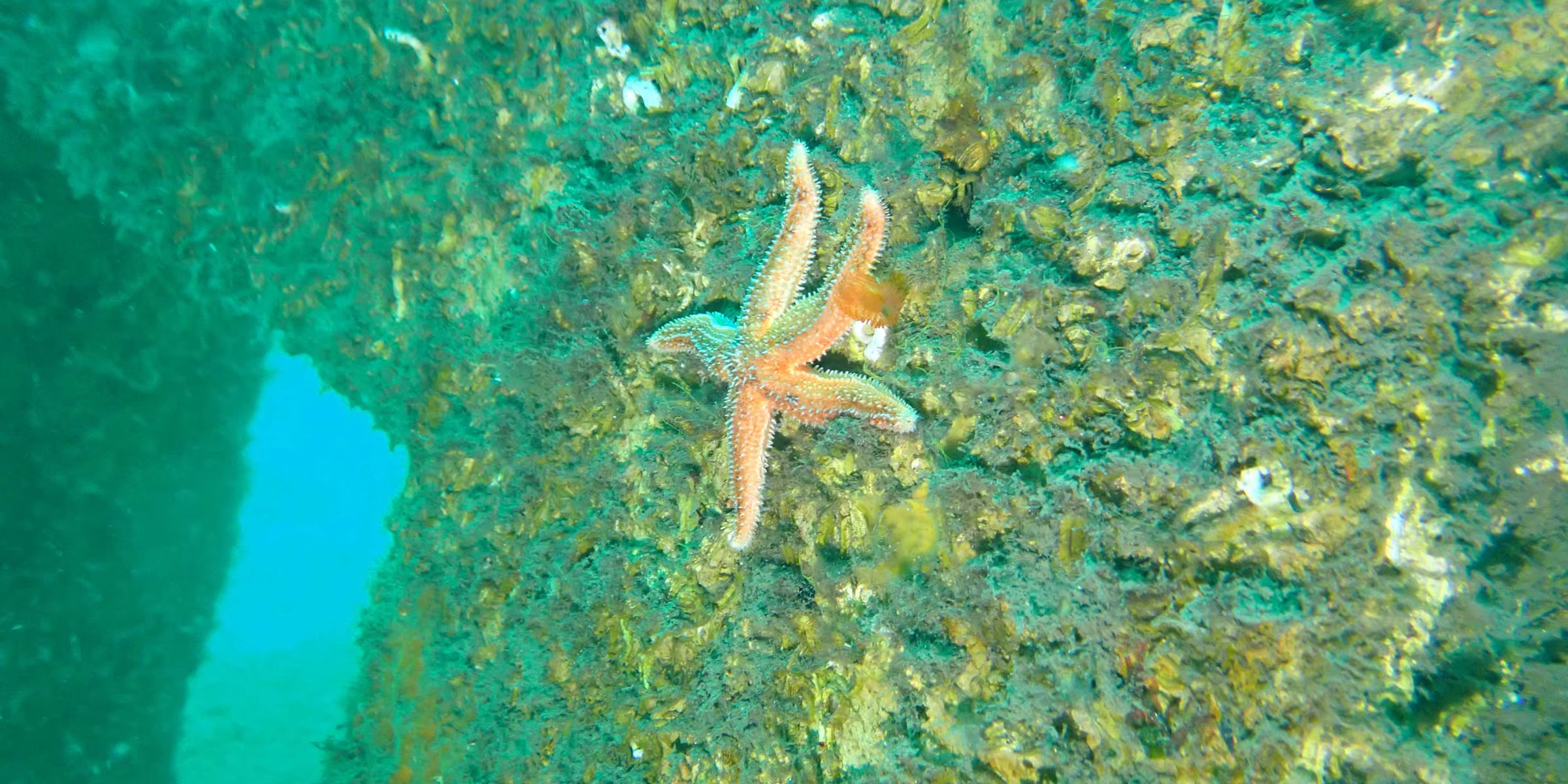
In 2025, we recovered and utilized a total of 110,201 m3 of rainwater-generated surface runoff.
Actions and Resources Related to Water and Marine Resources
With the digital water monitoring system implemented at the Çanakkale Plant, real-time water consumption monitoring has also been enabled at our Ladik and Büyükçekmece plants as of 2025. Feasibility studies for extending this system to other business lines will be conducted in 2026. Through closed-loop systems, water recovery rates are increased and operational efficiency is supported. In addition, the modernization of the wastewater treatment facilities at the Çanakkale Plant has been completed, improving treatment efficiency.
At the Ladik Plant, a rainwater harvesting and surface runoff recycling system has been commissioned and is used as an alternative water source in cooling towers through physical treatment. In 2025, a total of 5,951 m3 of treated water was used in the cooling tower. At the Büyükçekmece Plant, infrastructure investments aimed at using alternative water sources are being expanded in response to high water stress risk. With the digital water consumption monitoring system completed in 2025 and the rainwater harvesting and surface runoff recycling project, 2,389 m3 of treated water was used as cooling water. Based on the effective surface areas and rainfall amounts at our ready-mix concrete plants, it is estimated that 20,826 m3 of water was beneficially utilized through recycling pools.
Through these projects, the amount of rainwater and surface runoff used as alternative water sources reached 110,201 tons. Financial and technological resources are allocated for the projects identified under the Water Master Plan, and risk analyses are conducted in line with the ISO 14001 Environmental Management System and TCFD recommendations, ensuring that action plans remain up to date. By implementing best practices in operational processes, water consumption is reduced and sustainable water management objectives are supported.
To ensure the effective implementation of water management strategies, regular training programs are provided to field teams, and awareness activities are carried out regarding the use of water management technologies and monitoring processes.
Water stress is particularly concentrated in the Marmara, North Aegean, and Black Sea regions, and strategies are continuously developed to ensure the security of water, which is a critical resource in cement production, and to optimize its consumption. At facilities located in water-stressed areas, measures such as efficiency projects, water recovery systems, and the use of treated wastewater are implemented.
20%
Reduction in water withdrawal achieved in 2025
Water Management Plans and Water Master Plans have been prepared to ensure the effective management of water-related risks. With the inclusion of the ready-mix concrete business line in 2025, these plans now represent the total water consumption across our operations. In water resource management processes, active collaboration is maintained with local communities, regulatory authorities, customers, employees, suppliers, and water service providers, strengthening efforts to reduce risks and leverage opportunities.
Water stress is experienced at varying levels across the regions where Akçansa operates. According to analyses conducted using the World Resources Institute’s WRI Aqueduct tool, eight facilities are located in areas with high water stress (40–80%), while thirteen facilities are located in areas with extremely high water stress (above 80%). Accordingly, water management strategies are designed to minimize these risks, and initiatives such as water efficiency projects, water recovery systems, and the reuse of treated wastewater are implemented.
Water stress is particularly concentrated in the Marmara, North Aegean, and Black Sea regions, and strategies are continuously developed to ensure the security of water, which is a critical resource in cement production, and to optimize its consumption. At facilities located in water-stressed areas, measures such as efficiency projects, water recovery systems, and the use of treated wastewater are implemented.
We analyze water-related risks, implement practices aimed at reducing water consumption, and utilize innovative methods to increase water recovery.
Water Management Performance Indicators
To protect water and marine resources and improve water management performance, our primary objective is to reduce the use of natural freshwater resources. In this context, we plan to reduce total water withdrawal per ton of cementitious product by 20% by 2030, compared with the 2022 baseline year. While a 15% reduction in water withdrawal was achieved in 2024, this figure increased to 16.1% in 2025.
During 2025, a total of 2.1 million m3 of water was withdrawn, approximately 1.9 million m3 of which was sourced from regions under high and extremely high water stress. Compared with the previous year, total water withdrawal decreased by approximately 4%, while withdrawals from high water stress regions decreased by 7%. In the cement business line, the share of water consumed in closed-loop systems reached 90%.